
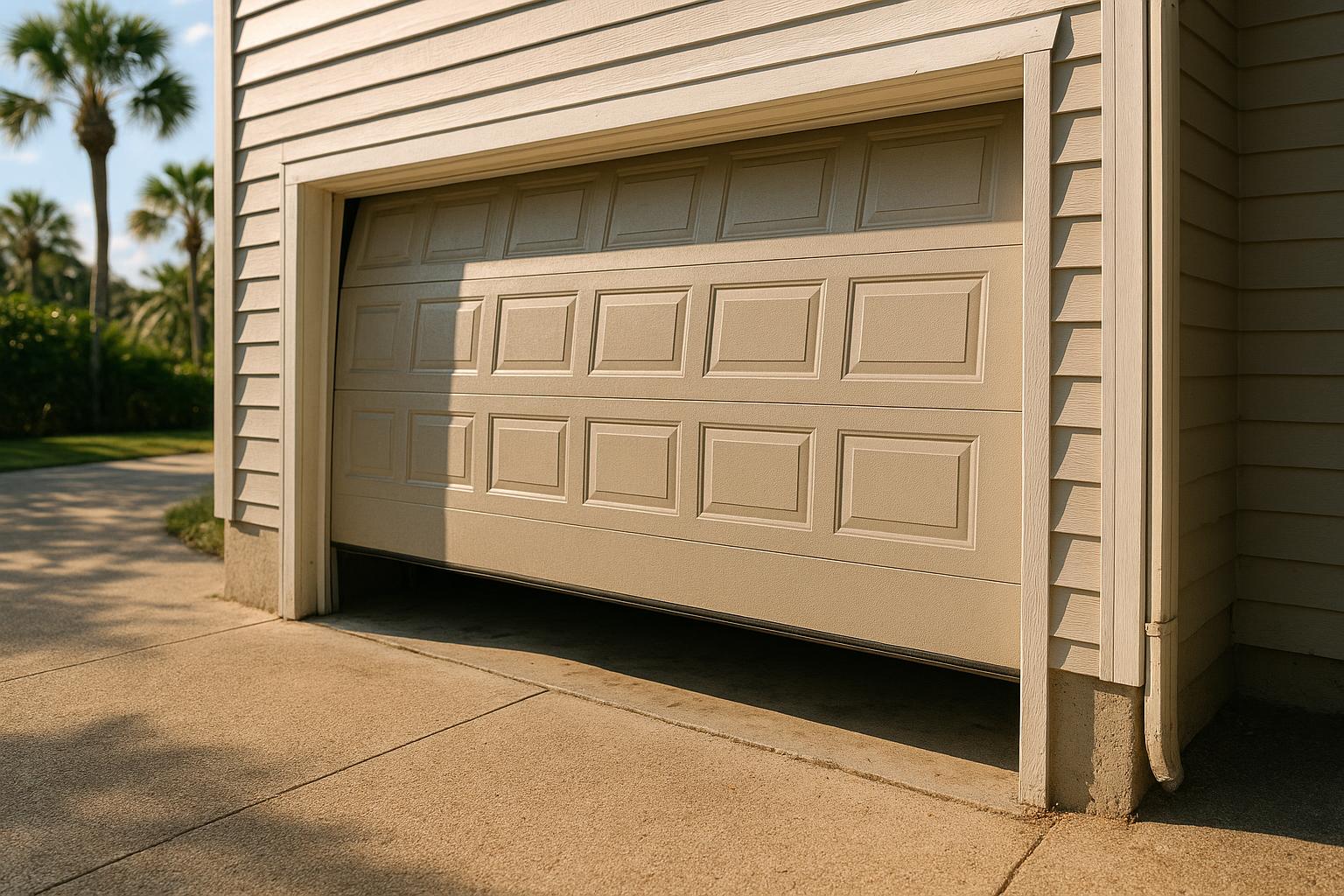
That Frustrating Moment When Your Garage Door Won't Stay Closed
You press the button on your remote, watch the garage door descend, and just before it touches the floor — it stops and reverses right back up. You try again. Same thing. Maybe you try holding the wall button, and it still won't cooperate. If you're a homeowner in St Augustine Beach dealing with this problem, you're not alone. This is one of the most common garage door issues we get calls about, and the good news is that it's almost always fixable.
Let's walk through the most likely reasons your garage door reverses before closing completely and what you can do about each one.
1. Misaligned or Dirty Safety Sensors
This is the number one cause of a garage door that reverses before reaching the floor. Every modern garage door opener manufactured after 1993 is required to have photoelectric safety sensors — small devices mounted near the bottom of the door tracks on either side. They project an invisible beam across the opening, and if anything breaks that beam, the door reverses to prevent crushing a person, pet, or object.
Here's the thing: these sensors don't have to be blocked by something obvious. A buildup of dirt, cobwebs, or salt residue (very common in our coastal St Augustine Beach climate) can interfere with the beam. Even direct sunlight hitting the sensor lens at certain times of day can cause false readings.
What to Check
- Look at the LED lights on both sensors. Most models show a steady green light on the receiving sensor when aligned properly. A blinking light usually means misalignment or obstruction.
- Wipe both sensor lenses with a soft, dry cloth.
- Make sure neither sensor has been bumped or shifted — a bicycle leaning against one or a broom knocking it askew is all it takes.
- Check that the sensor wires aren't damaged, frayed, or disconnected.
If cleaning and realigning the sensors doesn't solve the problem, the sensors themselves may need to be replaced. This is a quick and affordable repair that our team handles regularly for homeowners across Anastasia Island and the surrounding beaches.
2. Incorrect Close-Limit Settings
Your garage door opener has internal settings called travel limits that tell the motor exactly how far the door should move when opening and closing. If the close-limit setting is off — even by a small amount — the opener may interpret the door touching the ground as hitting an obstruction, which triggers the auto-reverse safety feature.
This issue often shows up after a new opener installation, a spring replacement, or even seasonal temperature changes that cause your garage door tracks and hardware to expand or contract slightly. In a place like St Augustine Beach, where humidity and temperature swings are part of life, these small shifts happen more often than you might think.
What to Do
Most openers have adjustment screws or digital controls for the travel limits. Your owner's manual will show you where they are and how to make small adjustments. The key word is small — turn the close-limit adjustment in tiny increments and test after each change. Over-adjusting can create new problems, including the door pressing too hard against the floor and straining the opener motor.
If you're not comfortable making this adjustment yourself, it's a straightforward service call. Our technicians can dial in the settings in minutes.
3. Worn or Broken Garage Door Springs
Your garage door springs do the heavy lifting — literally. They counterbalance the weight of the door so the opener motor doesn't have to work as hard. When springs wear out or break, the door becomes significantly heavier for the opener to move. The motor may struggle to lower the door smoothly, and the opener's force settings may trigger a reversal because it detects more resistance than expected.
Signs of a spring problem include:
- The door feels unusually heavy when you try to lift it manually.
- The door closes unevenly or appears crooked.
- You heard a loud bang from the garage — this is often the sound of a spring snapping.
- There's a visible gap in one of the torsion springs above the door.
Important safety note: Garage door springs are under extreme tension and can cause serious injury if handled improperly. Spring replacement is not a DIY job. If you suspect a broken or worn spring, call a professional. Our team provides spring replacement services throughout St Augustine Beach, Crescent Beach, Butler Beach, and Vilano Beach.
4. Problems with the Garage Door Track or Rollers
If the tracks that guide your garage door are bent, rusted, or obstructed, the door can bind or stick as it moves. When the opener senses this extra resistance, it may reverse the door as a safety precaution. Similarly, worn-out or seized rollers create friction that the opener interprets as an obstruction.
Living near the coast accelerates wear on metal components. Salt air is corrosive, and we regularly see rust and corrosion on garage door tracks and hardware in homes just blocks from the beach. Regular preventive maintenance — including lubrication and inspection of tracks, rollers, and hinges — goes a long way toward preventing these issues.
5. The Opener's Force Settings Need Adjustment
In addition to travel limits, your garage door opener has force settings that control how much power the motor uses to open and close the door. If the closing force is set too low, the opener may not have enough power to push the door all the way down, especially if there's even minor friction in the system. The opener interprets the resistance as an obstruction and reverses.
Like travel limit adjustments, force settings should be changed in small increments. Setting the force too high can be dangerous — it could override the safety reverse feature, which exists to protect people and property.
When to Call a Professional
Some of these fixes — cleaning sensors, checking for obstructions — are simple enough for any homeowner to handle. But when the problem involves springs, track damage, motor issues, or settings you're unsure about, it's worth calling in a professional. Garage doors are the largest moving component in most homes, and working on them without proper knowledge and tools can lead to injury or further damage.
At St Augustine Beach Garage & Gate, we diagnose and repair garage door reversal issues every week. Whether you're in a beachfront home on Anastasia Island or a neighborhood in St Augustine, we can usually identify the problem quickly and get your door working properly the same day.
Prevent the Problem Before It Starts
The best way to avoid a garage door that won't close is regular preventive maintenance. A professional tune-up once or twice a year keeps all the components in good working order and catches small issues before they become big headaches. This is especially important in our coastal environment, where salt air, humidity, and sand take a toll on garage door systems faster than in inland areas.
If your garage door is reversing and you can't figure out why, don't keep pressing the button and hoping for the best. Give us a call and let us take a look. It's usually a straightforward fix, and you'll have peace of mind knowing your door is operating safely and reliably.